
Artificial Intelligence has ceased to be merely a tool for answering questions. Today, it is beginning to assume a much more strategic role: supporting tasks, maintaining context, using tools, creating routines, organizing processes, and helping people and companies work more efficiently.
It is in this context that interest in AI agents, such as the Hermes Agent , arises .
While many people still only use AI to request texts, summaries, or ideas, agents represent a new step. They don’t just respond. They can operate in their own environment, retain memory, use skills, interact with tools, and participate in more complete workflows.
The Hermes Agent stands out precisely because of this proposition. It is presented as a self-hosted agent, with persistent memory, skill creation, tool usage, and the ability to communicate through platforms such as Telegram, Slack, and Discord. ( Hermes Agent )
But to harness this potential, it’s necessary to understand an important truth: an AI agent shouldn’t be used haphazardly. It needs structure, security, method, and human oversight.
The Hermes Agent is an Artificial Intelligence agent designed to function persistently. This means it can continue operating on a server even when the user’s personal computer is turned off.
In practice, it can be installed in an environment like a VPS, run with Docker, connect to language templates, maintain memory, create reusable skills, and interact with the user through channels such as terminals or messaging applications. The project’s public documentation highlights features such as memory, skills created from experience, and operation through tools and gateways. ( GitHub )
In simple terms, we can say that Hermes Agent is like a configurable digital collaborator. It doesn’t replace the user, but it can help organize, write, review, research, execute routines, and maintain continuity in projects.
A typical chatbot answers your questions. It can write text, explain a concept, or generate an idea. This is already useful, but it’s still limited.
An AI agent goes even further. It can maintain context, use tools, query files, execute authorized commands, follow procedures, and participate in recurring workflows.
For example, a chatbot can tell you how to check Docker logs. An agent, if properly configured and authorized, can then help you query those logs.
A chatbot can suggest post ideas. An agent can maintain an editorial calendar, generate drafts, review SEO, and send the material for approval.
This difference changes how AI is used. The user stops simply asking questions and starts delegating tasks methodically.
For persistent operation, the Hermes Agent requires a stable environment. A personal laptop may be suitable for testing, but it is not ideal for continuous operation. If the laptop shuts down, suspends, or loses internet access, the agent will stop.
Therefore, a VPS is usually a more suitable solution. The VPS functions as a server in the cloud, remaining continuously online and allowing Hermes to operate more stably.
Docker, in turn, helps to organize and isolate the agent environment. Instead of installing everything directly on the main system, Docker allows Hermes to run inside a container, facilitating maintenance, updates, and dependency separation.
For those looking to start with an online infrastructure to host projects like Hermes Agent, it’s worth exploring a VPS option by clicking here .
Hermes Agent can be applied in various areas. For writers, it can help with creating ebooks, organizing chapters, reviewing coherence, generating blog posts, and preparing promotional materials.
For entrepreneurs, it can help organize tasks, create reports, structure proposals, prepare business responses, and track processes.
For content creators, it can support editorial calendars, SEO, copywriting, video scripts, subtitles, and repurposing long-form content.
For technical users, it can assist in diagnosing logs, reviewing configurations, documentation, automations, and integration with tools such as WordPress and n8n.
The key point is that Hermes becomes most useful when given a clear purpose. It shouldn’t be used merely out of curiosity, but to solve real and recurring tasks.
One of the biggest problems in the common use of AI is having to repeat everything. The user explains the language pattern, the project’s objective, the target audience, the writing rules, and the preferences. After some time, they need to explain everything again.
In Hermes Agent, memory and skills help to mitigate this problem.
Memory allows us to preserve preferences, context, and useful information. Skills function as reusable procedures. If a task is repeated many times, it can become a skill.
For example, a writer might have a skill for reviewing e-book chapters. A technician might have a skill for diagnosing problems in Docker. A content creator might have a skill for transforming chapters into blog posts.
This creates continuity and standardization.
The more power an agent receives, the more security he demands.
If Hermes can use tools, access files, chat via Telegram, query APIs, or execute commands, it needs limits. This includes protecting API keys, configuring allowlists, preventing excessive permissions, requiring human confirmation for sensitive actions, and maintaining backups.
The rule is simple: the agent must have sufficient power to do their job, but never unlimited power to cause harm.
Publishing posts, sending emails, deleting files, modifying databases, or executing administrative commands are actions that require human confirmation.
One of the most interesting uses of Hermes Agent is in content creation. It can help transform ideas into organized texts, chapters into posts, posts into captions, long content into scripts, and ebooks into promotional campaigns.
A simple workflow could look like this:
The user writes or approves a chapter.
Hermes creates an editorial summary.
Then it generates a blog post.
Next, it prepares meta descriptions and keywords.
Then it creates captions for social media.
Finally, it sends everything for review.
This type of workflow saves time without removing human control.
Hermes can also be part of an integrated digital ecosystem. It can generate drafts for WordPress, organize editorial calendars, work with spreadsheets, and connect to workflows created in n8n.
Ideally, you should start with drafts. Hermes prepares the content, the user reviews it, and only then is the content published.
Over time, it’s possible to create more advanced workflows, such as sending a draft to WordPress, recording the content in a spreadsheet, and notifying users via Telegram that the material is ready for review.
But everything must be done securely. Webhooks need protection, credentials should have limited permissions, and automatic publishing should be avoided at first.
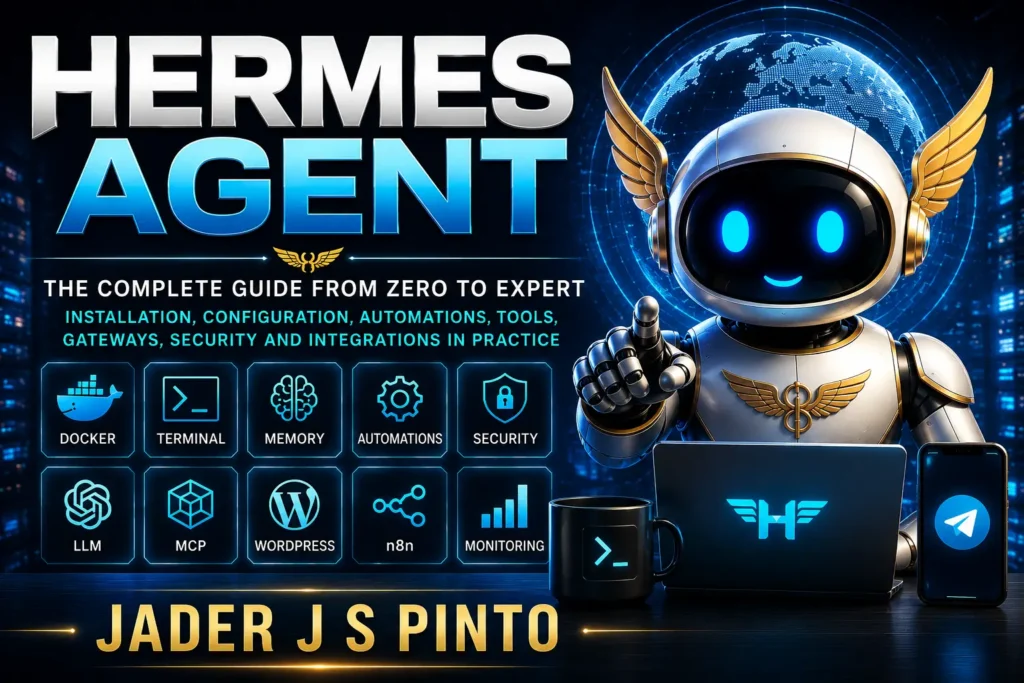
The e-book “Hermes Agent — Complete Guide from Zero to Expert” is recommended for those who want to learn the subject in depth, but without overly technical language.
It is ideal for:
Writers who want to organize ebooks and content;
entrepreneurs who want to securely automate tasks;
content creators who need editorial consistency;
technology professionals who want to understand persistent agents;
novice users who want to learn VPS, Docker, LLM, APIs, and automations step-by-step;
people who want to move beyond basic AI use and advance to conscious digital delegation.
Hermes Agent represents a new phase in the use of Artificial Intelligence. It allows you to go beyond conversation and start building real processes for productivity, memory, automation, and digital integration.
But the real value isn’t just in the technology. It’s in how it’s used.
With a clear objective, adequate infrastructure, security, well-organized memory, reviewed skills, automations with limits, and human review, Hermes can become a powerful digital collaborator.
If you want to learn this path completely, step by step, the e-book “Hermes Agent — Complete Guide from Zero to Expert” was created to guide you from the fundamentals to strategic use.
Start your journey now and discover how to transform Artificial Intelligence into a real tool for productivity, creation, and conscious digital delegation.